Collaborative projects using artificial intelligence to foster critical thinking and economic revitalization within the Technical Baccalaureate program in Ecuador.
DOI:
https://doi.org/10.67169/publicarciencia.V7i1.43Keywords:
artificial intelligence, critical thinking, collaborative projects, technical high school programAbstract
This article analyzes how collaborative projects supported by artificial intelligence (AI)—particularly those utilizing tools like ChatGPT—contribute to the development of critical thinking among students in Technical High School programs in Ecuador. It posits that the pedagogical integration of AI not only strengthens higher-order cognitive skills but also drives innovation, entrepreneurship, and local economic revitalization. The proposal is based on an initiative implemented within the Garment Manufacturing specialization, offering potential for replication in other technical fields. Using a qualitative-descriptive approach, projects were designed to combine AI with collaborative work, resulting in improvements in argumentation, creativity, and the generation of context-specific solutions. The findings suggest that this methodology fosters key competencies and supports sustainable economic development.
Downloads
References
Bates, A. W. (2019). Teaching in a digital age (2nd ed.). Tony Bates Associates.
Bloom, B. S. (Ed.). (1956). Taxonomy of educational objectives: The classification of educational goals. Handbook I: Cognitive domain. David McKay.
Braun, V., & Clarke, V. (2006). Using thematic analysis in psychology. Qualitative Research in Psychology, 3(2), 77–101. https://doi.org/10.1191/1478088706qp063oa
Bryman, A. (2016). Social research methods (5th ed.). Oxford University Press.
Cohen, L., Manion, L., & Morrison, K. (2018). Research methods in education (8th ed.). Routledge.
Creswell, J. W. (2014). Research design: Qualitative, quantitative, and mixed methods approaches (4th ed.). Sage.
Ennis, R. H. (2011). The nature of critical thinking: An outline of critical thinking dispositions and abilities. University of Illinois.
Facione, P. A. (1990). Critical thinking: A statement of expert consensus for purposes of educational assessment and instruction. The California Academic Press.
García, A., & Torres, L. (2020). Innovación en la educación técnica: Retos y oportunidades en Ecuador. Revista Iberoamericana de Educación, 82(1), 45–62.
García Aretio, L. (2020). Educación a distancia y virtual en América Latina. Revista Española de Pedagogía, 78(276), 219–236.
Ministerio de Educación del Ecuador. (2023). Currículo del Bachillerato Técnico. https://educacion.gob.ec/curriculo-bachillerato-tecnico/
OpenAI. (2023). Guía para el uso educativo de ChatGPT. https://openai.com/education
Richards, J. C., & Rodgers, T. S. (2014). Approaches and methods in language teaching (3rd ed.). Cambridge University Press.
Salinas, J. (2022). Innovación y aprendizaje con tecnología. Revista Iberoamericana de Educación, 88(1), 15–30.
Thomas, J. W. (2000). A review of research on project-based learning. Autodesk Foundation.
UNESCO. (2021). Transformar la educación técnica y profesional para un desarrollo sostenible. UNESCO Publishing. https://unesdoc.unesco.org/ark:/48223/pf0000378715
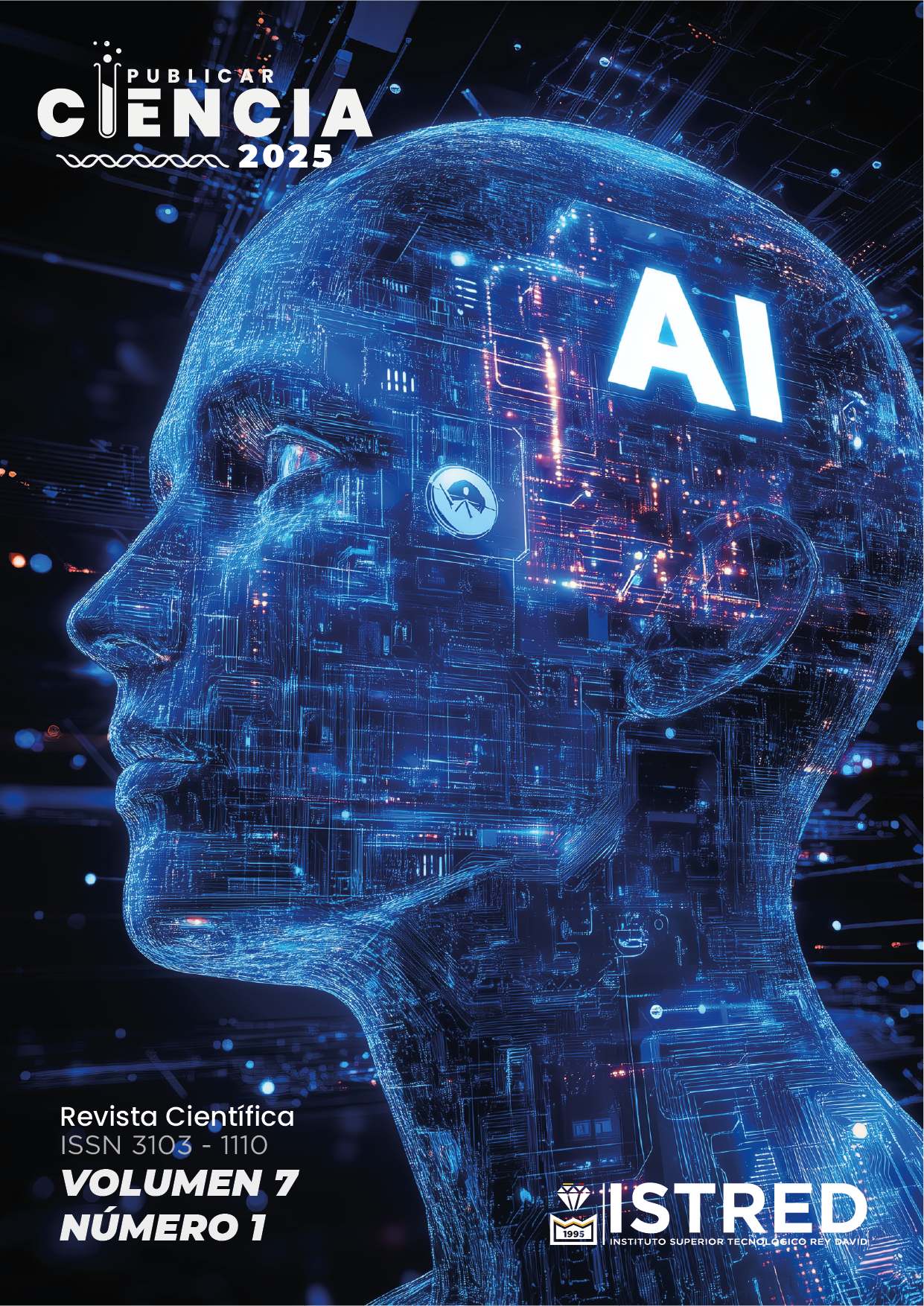
Downloads
Published
Issue
Section
License
Copyright (c) 2025 Alexandra Tapia Castillo (Autor/a)

This work is licensed under a Creative Commons Attribution-NonCommercial-ShareAlike 4.0 International License.